

Mumbai’s Growing Road Rage Crisis: When Everyday Disputes Turn Deadly
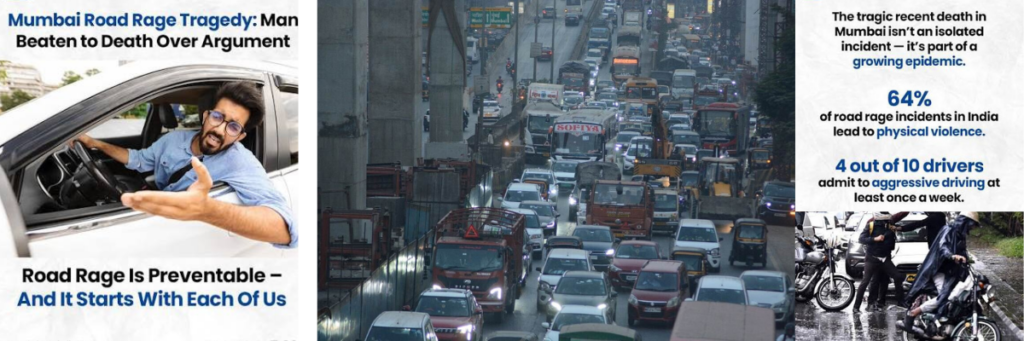
Home For decades, Mumbai has been celebrated as one of India’s safest and most resilient cities. Its fast-paced spirit, efficient public transport system, and ability to keep moving despite immense pressure have long been admired.However, a disturbing trend is beginning to challenge that image.Across Mumbai and the wider Maharashtra region, incidents of road rage and commuter violence are increasing at an alarming rate. What once may have ended as a heated exchange of words is now, in some cases, escalating into serious assaults and even murder. Minor disagreements over parking, overtaking, lane changes, or crowding in public transport are turning fatal within minutes.Why Is This Happening?Experts and urban observers point to a combination of factors:Severe traffic congestionLengthy daily commutesRising stress levelsFinancial and professional pressuresOvercrowded public spacesReduced patience and emotional control In a city where millions spend hours navigating roads and trains every day, frustration often builds up beneath the surface. Increasingly, even small triggers are resulting in disproportionate reactions. Recent Incidents That Shocked MaharashtraThe Dadar T2 Circle MurderA 63-year-old retired BMC employee reportedly lost his life after objecting to a vehicle being parked in a restricted area beneath the Dadar flyover. What began as a simple objection quickly escalated into a violent assault. Thane Tempo Driver AssaultIn the Shil-Daighar area of Thane, a minor collision between a tempo and a two-wheeler resulted in a shocking act of retaliation. The young tempo driver was allegedly tracked down to his residence and assaulted, later succumbing to his injuries.Malad Mob LynchingA routine traffic disagreement involving an auto-rickshaw overtaking another vehicle spiraled into mob violence. A young man was beaten to death in front of his family following the altercation.Expressway ViolenceReports have increasingly highlighted aggressive confrontations on Mumbai’s major highways, including the Western Express Highway (WEH) and Eastern Express Highway (EEH). Incidents involving dangerous chases, physical assaults, and even stabbings have been linked to seemingly minor driving disputes.Beyond DrivingA man walking on the footpath accidently bumps into another a mobile phone falls and the screen is cracked . The owner demands payment and later beats the other. Fortunately the injured man was taken to a hospital and he survived.The Problem Extends Beyond RoadsRoad rage is no longer confined to highways and intersections.Mumbai’s suburban railway network, often referred to as the city’s lifeline, has also witnessed shocking incidents of extreme violence.The Monsoon Door DisputeA disagreement between commuters over whether a train compartment door should remain closed during heavy rains reportedly escalated into a fatal stabbing inside a moving local train.The Malad Station Professor CaseHeavy crowding during deboarding led to a minor altercation that ultimately turned deadly, resulting in the loss of a college professor’s life.Ladies Compartment FightsFor years we’ve heard and witnessed women attacking each other in railway compartments and it’s never taken seriously but now can we afford to not address this menace?These incidents reveal a troubling reality: public frustration is spilling over into spaces that millions depend upon every day. Over the years many commuters have lost their lives crossing tracks or falling out of crowded compartments but being murdered by a co – passenger is just unthinkable and unacceptable. The daily commuter sees the railway as a true lifeline let’s not let it become a life threatening space.What Citizens Are SayingSocial media platforms, blogs, and community forums have become spaces where Mumbaikars openly discuss their concerns.Many residents feel that Mumbai’s traditional reputation as a safe city is under pressure. Reports of aggressive confrontations, intimidation, and violent retaliation are creating a growing sense of unease.The Bystander EffectOne recurring concern is the lack of intervention during violent incidents. Witnesses often choose to record events on their phones rather than step in or seek immediate help.While personal safety remains important, the trend has raised questions about collective responsibility in public spaces.When asked how to avoid being a victim the common answer is ignore the abuse…drive away , walk away do not react !!Mumbai Traffic Police and road safety experts recommend the following precautions:While incidents can happen anywhere, they are more likely to occur in areas affected by chronic congestion and traffic bottlenecks.Stay Inside Your VehicleLock all doors immediately.Keep windows rolled up.Avoid stepping out to argue.Avoid EscalationDo not engage in verbal abuse.Avoid eye contact, aggressive gestures, or retaliatory behavior.Allow aggressive drivers to move ahead if possible.Record EvidenceDo not drive home if someone is following you.Head toward:The nearest police stationA crowded public areaDial 112 for emergency assistance.Seek immediate police intervention if threatened.Road rage is a global phenomenon …so how is the world coping??Countries around the world have realized that road rage and transit violence are not merely traffic violations—they are public safety and behavioural issues requiring a multi-pronged response.Germany treats aggressive driving as a criminal offense. Behaviours such as tailgating, intimidating other drivers, or abusive gestures can result in hefty fines, licence suspension, and even imprisonment.Australia follows a zero-tolerance approach while The United Kingdom focuses on behavioural correction. Drivers involved in minor aggressive driving incidents may be required to attend awareness and anger-management programmes .Singapore has strengthened citizen participation by enabling commuters and motorists to easily submit dashcam footage of dangerous driving directly to authorities, increasing accountability and deterrence.Meanwhile, Japan and The Netherlands focus on prevention through better infrastructure. Efficient public transport systems, clear passenger flow management, safer road design, and reduced congestion help lower the frustration that often triggers aggressive behaviour.The Takeaway for IndiaAs incidents of road rage and transit violence rise across Indian cities, the solution cannot rely on policing alone. Stronger laws, faster enforcement, behavioural awareness programmes, improved surveillance, better public transport management, and smarter urban planning must work together.The global experience shows that reducing rage on roads and in transit systems requires addressing not just the offender, but also the environment that fuels the anger.