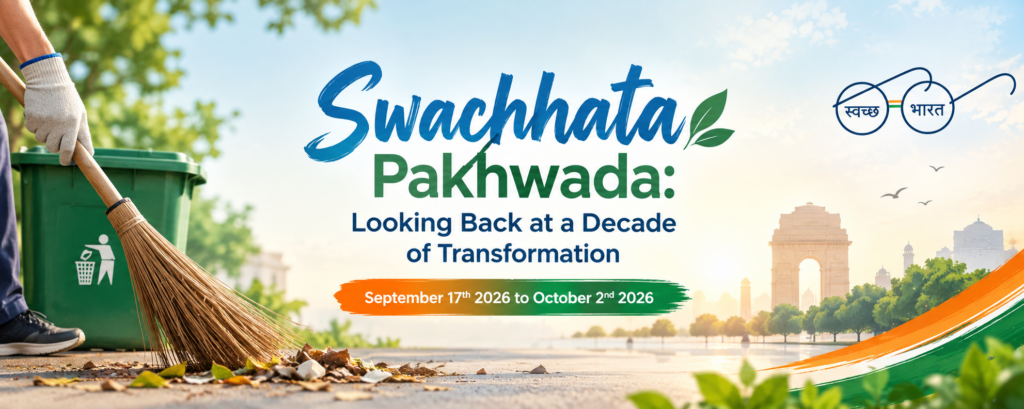
Home Launched in April 2016 under the larger vision of the Swachh Bharat Mission, Swachhata Pakhwada brought a focused two-week period of cleanliness and sanitation activities across government ministries, departments and public sector organisations.A decade ago, cleanliness was largely seen as a task that needed to be undertaken after things became dirty. Today, the conversation is increasingly about preventing waste, managing it responsibly and making cleanliness a part of everyday life.What began as a concentrated cleanliness drive has, over the years, evolved into something much larger: a sustained effort to make cleanliness a habit, a responsibility and an integral part of governance. A Decade That Changed the Meaning of CleanlinessWhen the Swachh Bharat Mission was launched on October 2, 2014, India embarked on one of its most ambitious civic movements.The early focus was understandably on the basics — sanitation infrastructure, toilets, hygiene and public participation.But as the movement matured, the idea of Swachhata expanded.It was no longer simply about picking up a broom and cleaning streets for a photo op. It became about how we generate waste, how we segregate it, how we dispose of it and, increasingly, how we prevent it from being generated in the first place.From Shramdaan to SystemsThe initial years placed considerable emphasis on Shramdaan, voluntary participation in cleanliness activities, alongside the creation of sanitation infrastructure and widespread awareness and pledge-taking.The next stage brought greater institutionalisation. Cleanliness became part of departmental planning and budgeting, with government organisations undertaking dedicated sanitation, waste-management and sustainability initiatives.Today, the focus has moved further towards resource efficiency and the circular economy.Source segregation, recycling, reuse, responsible disposal of e-waste, reduction of single-use plastics and cleaner workplaces are now part of a much broader understanding of Swachhata.The broom may have been the original symbol. But the real transformation is happening in our systems and our behaviour. From Toilets to Better HealthOne of the most significant achievements of the Swachh Bharat movement has been the transformation in the way India views sanitation.The importance of toilets — not only in cities but also in rural India — has contributed to improved hygiene practices and greater awareness of the connection between sanitation, health and dignity.The lesson is simple:Cleanliness is not merely about how a place looks. It is about how people live. When Railway Stations Became CanvasesFew places demonstrate the changing face of Swachhata as vividly as India’s railway stations. The Railways, quite literally the lifeline of the country, have taken cleanliness beyond routine cleaning.Deep-cleaning of platforms, coaches and tracks, plastic-waste management, awareness campaigns and improved sanitation have become an ongoing effort.Today many railway stations look like art galleries. Walls and public spaces that once appeared purely functional have become colourful representations of the regions they belong to.The healthy competition between stations and railway divisions has added another dimension — encouraging each one to raise the bar and demonstrate what is possible.It is a reminder that cleanliness is also beautiful. The Power of CompetitionAnother major development in India’s cleanliness journey has been the rise of Swachh Survekshan. Launched in 2016 under the Swachh Bharat Mission, the annual survey created something powerful: healthy competition between cities and states.Cleanliness was no longer simply a government department’s responsibility. Cities began competing to improve sanitation, waste management, public spaces and citizen participation.Cities such as Indore and Navi Mumbai have demonstrated how sustained efforts can create strong models of urban cleanliness.The larger achievement, however, is the culture of aspiration that Swachh Survekshan has created.Cities want to do better.Citizens want their cities to do better.And that competition can become a powerful catalyst for change.The Next Decade: Less Waste, Not Just Better Waste ManagementAs we look ahead, the challenge is becoming more complex.The objective cannot simply be to clean up the waste we generate.It must increasingly be to generate less waste in the first place.This is where the principles of Reduce, Reuse and Recycle become critical.Source segregation is important. Recycling is important. Scientific waste management is important.But there is an even more fundamental question:Can we avoid creating that waste at all?Producing less waste is often easier — and far more sustainable — than trying to manage mountains of waste after they have been created.This is the thinking behind the next phase of Swachhata.The focus is shifting from cleaning up to responsible consumption, resource recovery and circularity. From Campaign to CultureThe most meaningful measure of Swachhata Pakhwada’s success may not be the number of cleanliness drives conducted during a fortnight.It is what happens after the fortnight ends.When someone segregates waste at home without being asked.When a child learns not to throw plastic on the street.When an office reduces paper waste.When a citizen chooses to reuse instead of discard.When a community comes together to keep its neighbourhood clean.That is when a campaign is successful.The message of “Swabhav Swachhata, Sanskaar Swachhata” captures this beautifully. Swachhata must move from an activity we perform to a value we practise. Our Role as an AgencyAs an agency, we believe communication can play an important role in this transformation. A cleanliness campaign cannot simply tell people to clean. It must make them care.Our role is to help amplify these important civic milestones — creating communication that is relevant, engaging and capable of reaching people across generations and communities.Because ultimately, a cleaner India cannot be created by campaigns alone. It is created by millions of responsible actions, repeated every day.One person acts responsibly.It becomes a habit.Habits become lifestyles.Millions of clean, responsible lifestyles become a movement.And every movement begins with each of us.Swachhata Pakhwada may last a fortnight.But Swachhata is a responsibility for every day.