


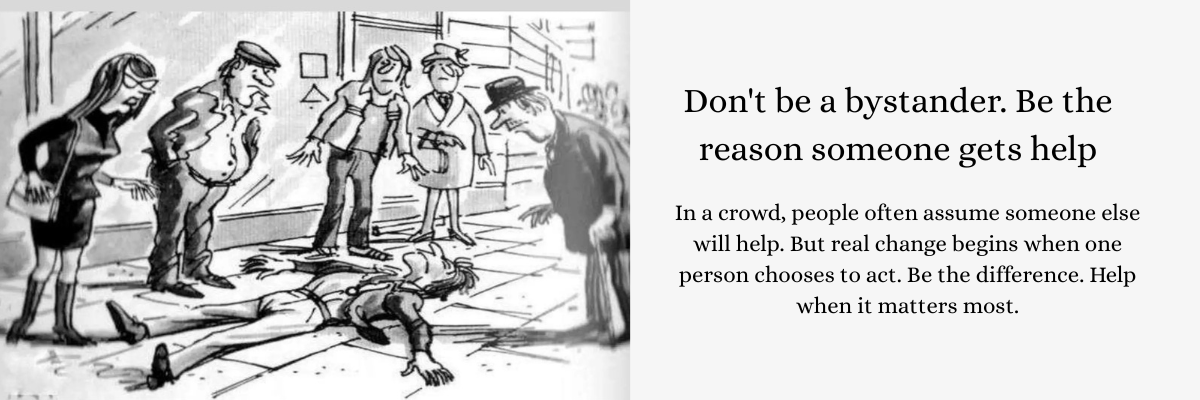
The Bystander Effect: When Everyone Watches and some photograph
A man is stabbed to death in a crowded train. A commuter collapses on a busy street. A woman is harassed in a packed railway compartment. An accident occurs in broad daylight.
Dozens of people witness these incidents. Some stop and stare. A few pull out their phones and start recording. Yet all too often, nobody steps forward.
This phenomenon is known as the Bystander Effect—the tendency of people to be less likely to help when others are present. Everyone assumes someone else will act, and in the end, nobody does.
Decades ago, a colleague came to work visibly disturbed. That morning, she had witnessed a young girl being badly molested in a crowded ladies’ compartment. I immediately asked her why she—or the other women present—had not intervened.
“They were all scared,” she replied. “What if he turned on us?”
I remember being shocked. In my mind, I was certain I would never have remained a silent witness.
In my college days, I had caught pickpockets and petty thieves on buses and trains more than once. It seemed like the right thing to do. My family, however, strongly disagreed. They warned me about the dangers of acting “extra smart,” as they called it, and gave me a thorough dressing-down every time.
Today, I suspect I would behave very differently. Age has made me less naïve and perhaps more aware of the risks. The truth is, I too have become more cautious—and more fearful.
That is the paradox of our times. We are more connected than ever before, yet when a situation demands human intervention, observation often replaces action.
The Age of Witnesses
The smartphone has transformed everyone into a photographer, videographer and broadcaster. Events that once went unnoticed are now recorded instantly and shared across the world within minutes.
But documentation is not intervention.
A disturbing question arises: Have we become more interested in capturing a moment than changing its outcome?
Photographs can be powerful. They expose injustice, reveal uncomfortable truths and sometimes spark social change. Yet there is a fine line between bearing witness and becoming a passive spectator.
Why Do People Freeze?
Psychologists offer several explanations for the bystander effect.
When many people are present, responsibility becomes diluted. Each person assumes someone else will step in.
Fear of Involvement
In the case of accidents, people are often in a hurry and reluctant to spend hours accompanying an injured stranger to a hospital or police station. Helping can feel like taking responsibility for an unknown person and an uncertain situation.
When violence is involved, the fear is even more understandable. A person witnessing an assault may worry that intervening could make them the next victim.
Waiting for someone else
People look to others for guidance. If everyone around appears calm or indifferent, individuals often conclude that the situation is not serious enough to warrant action.
The result is a strange collective paralysis in which everyone waits for someone else to make the first move.
Ironically, technology does offer one advantage.
Thanks to mobile phones and photographs, criminals can often be identified and apprehended much more quickly than before.
Too bad we often fail to stop the crime while it is happening.
The Courage of One
Research shows that the bystander effect can be broken by a single individual. Once one person takes action, others frequently follow. Courage, like fear, can be contagious.
In every crowd, there is an opportunity for someone to become more than a witness.
The next time we encounter a crisis, perhaps the question should not be:
“Why isn’t anyone doing something?”
Instead, we should ask:
“Why shouldn’t that someone be me?”
In an age where every moment can be photographed, the challenge is not merely to capture reality—it is to improve it..