


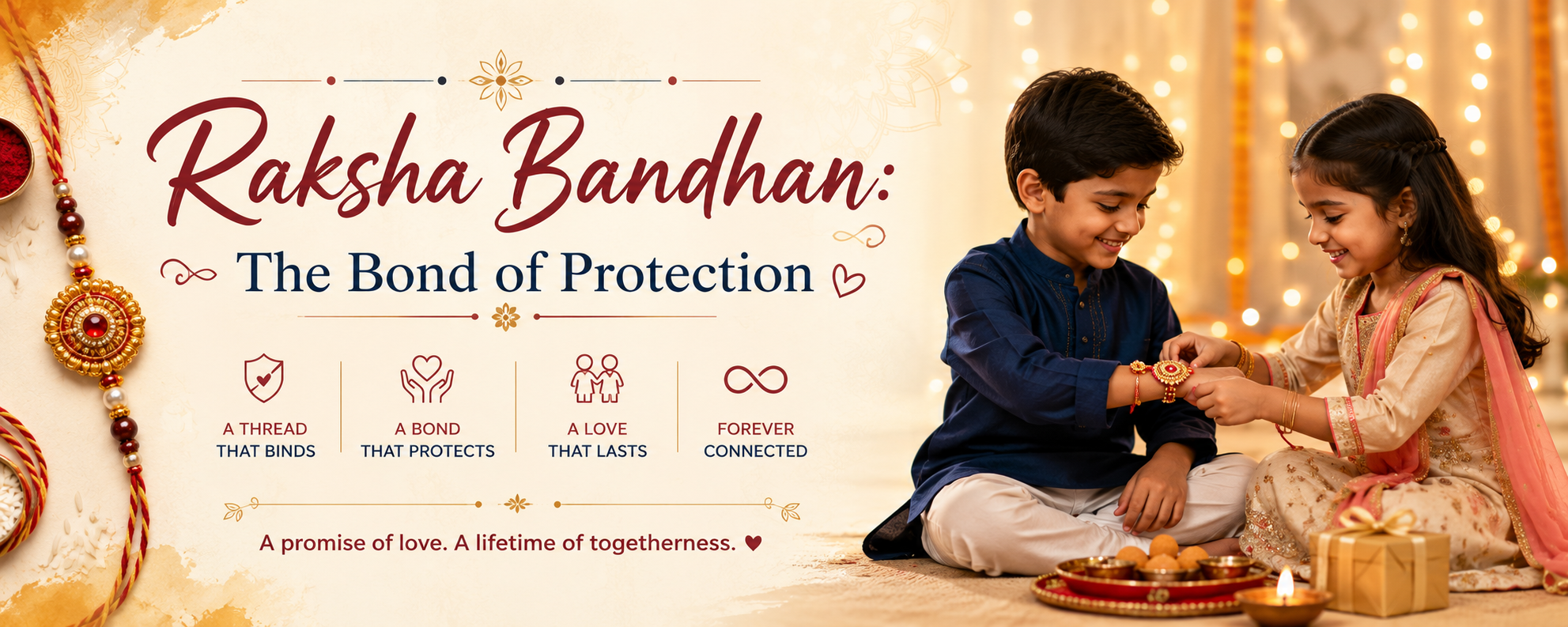
Raksha Bandhan: The Bond of Protection
India is a land of festivals, each celebrating a unique aspect of life and human relationships. Among them, Raksha Bandhan stands apart as a festival that honours one of the most cherished bonds—the bond of love, trust, and protection.
Derived from the Sanskrit words Raksha (protection) and Bandhan (bond or knot), Raksha Bandhan literally means “the bond of protection.” While it is traditionally celebrated between brothers and sisters, its true spirit extends far beyond family ties. It represents mutual care, responsibility, and unwavering support.
Like many Indian festivals, Raksha Bandhan is steeped in mythology. One of the most beloved legends is that of Lord Krishna and Draupadi. It is said that when Krishna injured his finger, Draupadi immediately tore a strip from her saree and tied it around his wound. Touched by her gesture, Krishna promised to protect her whenever she needed him. Years later, when Draupadi faced humiliation in the Kaurava court, Krishna came to her rescue, fulfilling his promise. This timeless story beautifully captures the essence of Raksha Bandhan—that genuine affection creates an unbreakable bond of protection.
History, too, offers inspiring examples. One such story is that of Maharani Jindan Kaur, the wife of Maharaja Ranjit Singh. After the fall of the Sikh Empire in 1849, she is believed to have sought refuge from Jung Bahadur Rana, the ruler of Nepal, by sending him a rakhi. Respecting the sanctity of the bond, he welcomed and protected her. Whether viewed as history or legend, the story reinforces the values of trust, honour, and standing by one’s word.
Raksha Bandhan also played a remarkable role during India’s freedom movement. In 1905, when the British partitioned Bengal, Rabindranath Tagore launched the Rakhi Mahotsav to promote unity between Hindus and Muslims. People tied rakhis to one another as a symbol of brotherhood, harmony, and national solidarity in peaceful protest against the division. Even today, this tradition survives in parts of West Bengal, where friends and neighbours exchange rakhis as a gesture of mutual respect and goodwill.
Over the centuries, Raksha Bandhan has evolved into a celebration that embraces all meaningful relationships. Brothers and sisters, cousins, friends, neighbours, and even people from different communities participate in the festival. It is not uncommon to see women tying rakhis to soldiers, police personnel, and other public servants as a mark of gratitude and trust in those who dedicate themselves to protecting society.
The rakhi itself has also transformed over time. What began as a simple sacred thread is now available in countless colours, designs, and materials—from handcrafted cotton threads to intricate creations adorned with silver, gold, and precious stones. Yet, regardless of its appearance or value, its emotional significance remains unchanged.
On Raksha Bandhan, sisters lovingly tie a rakhi around their brothers’ wrists, praying for their happiness, health, and prosperity. In return, brothers offer gifts and reaffirm their promise to stand beside their sisters through every challenge. Increasingly, this promise is understood as one of mutual respect and lifelong support rather than one-sided protection.
Modern lifestyles may keep families scattered across cities and continents, but distance has not diminished the spirit of the festival. Online rakhi stores, digital gift vouchers, and express delivery services ensure that siblings can celebrate together, no matter where they are. Video calls have become today’s family gatherings, proving that love and affection transcend geography.
Ultimately, Raksha Bandhan is much more than the tying of a decorative thread. It is a celebration of enduring relationships, trust, compassion, and the timeless human promise to care for one another. In a world that often feels increasingly divided, this simple thread continues to remind us that the strongest bonds are woven not by blood alone, but by love, faith, and shared responsibility.
Happy Raksha Bandhan!