

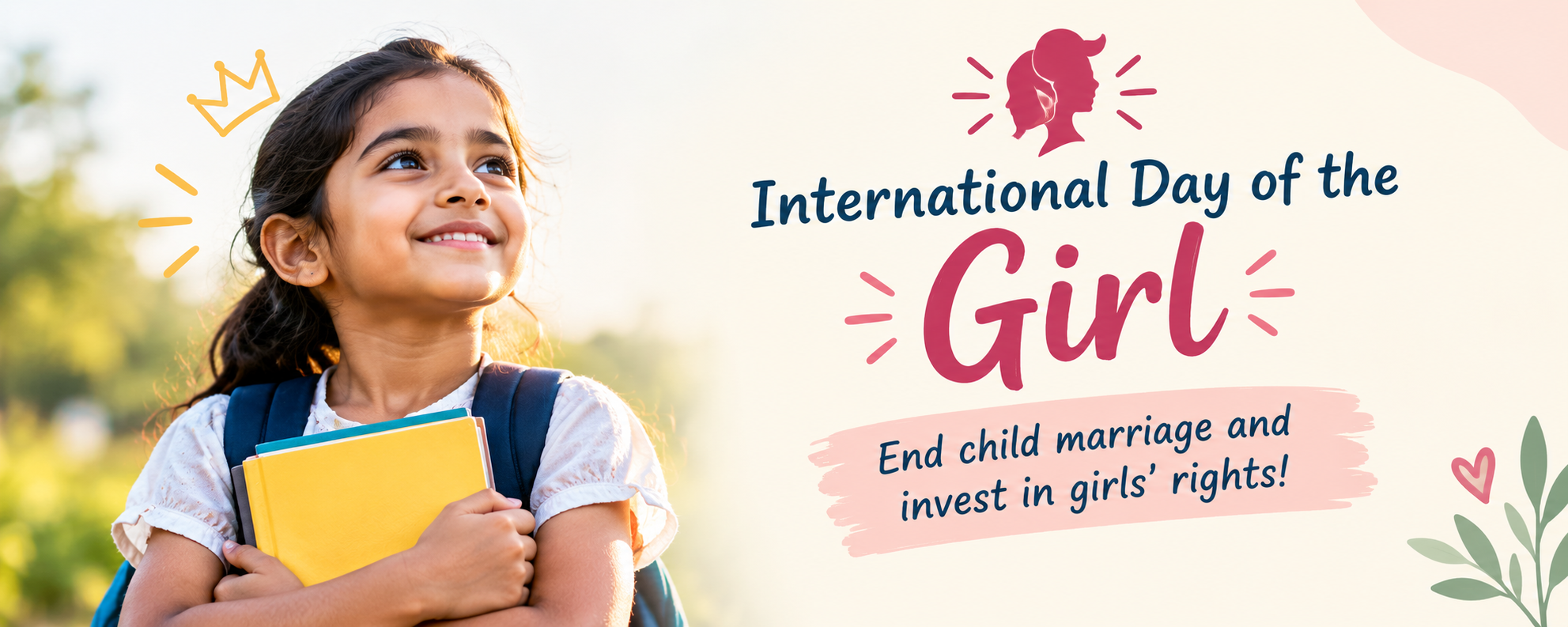
International Day of the Girl : End child marriage and invest in girls’ rights!
Celebrated every year on 11 October, International Day of the Girl is a global moment to celebrate girls everywhere. As announced by the United Nations , the 2026 theme is “End child marriage and invest in girls’ rights!”
Child marriage among girls is most common in South Asia and sub-Saharan Africa, and the 10 countries with the highest rates are found in these two regions. Niger has the highest overall prevalence of child marriage in the world. However, Bangladesh has the highest rate of marriage involving girls under age 15. South Asia is home to almost half (42 per cent) of all child brides worldwide; India alone accounts for one third of the global total.
Child marriage in India has declined significantly over the past two decades. According to national data, the national prevalence of child marriage among women dropped from about 47% in 2005–2006 down to around 20% to 23% in recent comprehensive surveys.
Despite this progress, India remains home to the largest total number of child brides in the world, accounting for roughly one-third of the global total. The practice remains more common in rural rather than urban areas.
When a young girl is forced into marriage, her life changes instantly. She is often pulled out of school, cutting short her education and trapping her in a cycle of limited opportunities. Physically and emotionally unready for marriage or childbirth, young brides face severe health risks, and many experience domestic or intimate partner violence. Hence, child marriage does not just hurt the individual girl; it holds back entire communities and perpetuates generational poverty.
Child marriage rates heavily correlate with lower education and household income. Under 5% of women with higher education marry before 18, compared to nearly half of those with no formal education. Poverty, deeply entrenched patriarchal structures, and localized cultural practices continue to sustain the issue.
The Indian government and campaigns like Bal Vivah Mukt Bharat, target high-burden districts to eliminate the practice by 2030. Additionally, the Supreme Court has issued binding directives to improve district accountability and support rehabilitation for victims.
India’s Beti Bachao Beti Padhao (BBBP) scheme is changing the status of girls in India by improving health metrics, boosting education numbers, and shifting social mind sets. While progress is visible, gaps remain. Overall, BBBP acts as a mind set-change movement that lays the groundwork for gender equality across India
For when girls are safe, educated and empowered, they don’t just transform their own lives, they help build healthier families, stronger communities and more peaceful, prosperous societies.
The National Girl Child Day is celebrated in India on January 24th . But , it’s not enough. We must consistently raise our voice for girls’ rights. Champion the solutions that help girls stay in school, stay safe and shape their own futures, especially in crisis and humanitarian settings.
Every girl deserves a childhood. Every girl deserves the freedom to learn, to grow, to make her own choices and to define her own future. Yet millions of girls are still denied that freedom.
It is rightly said that, a nation’s true progress and health are mirrored in the well-being, rights, and status of its women and that depends on how we raise our girls !!!
We require to stand with girls across the world…beginning with those in our own families.