


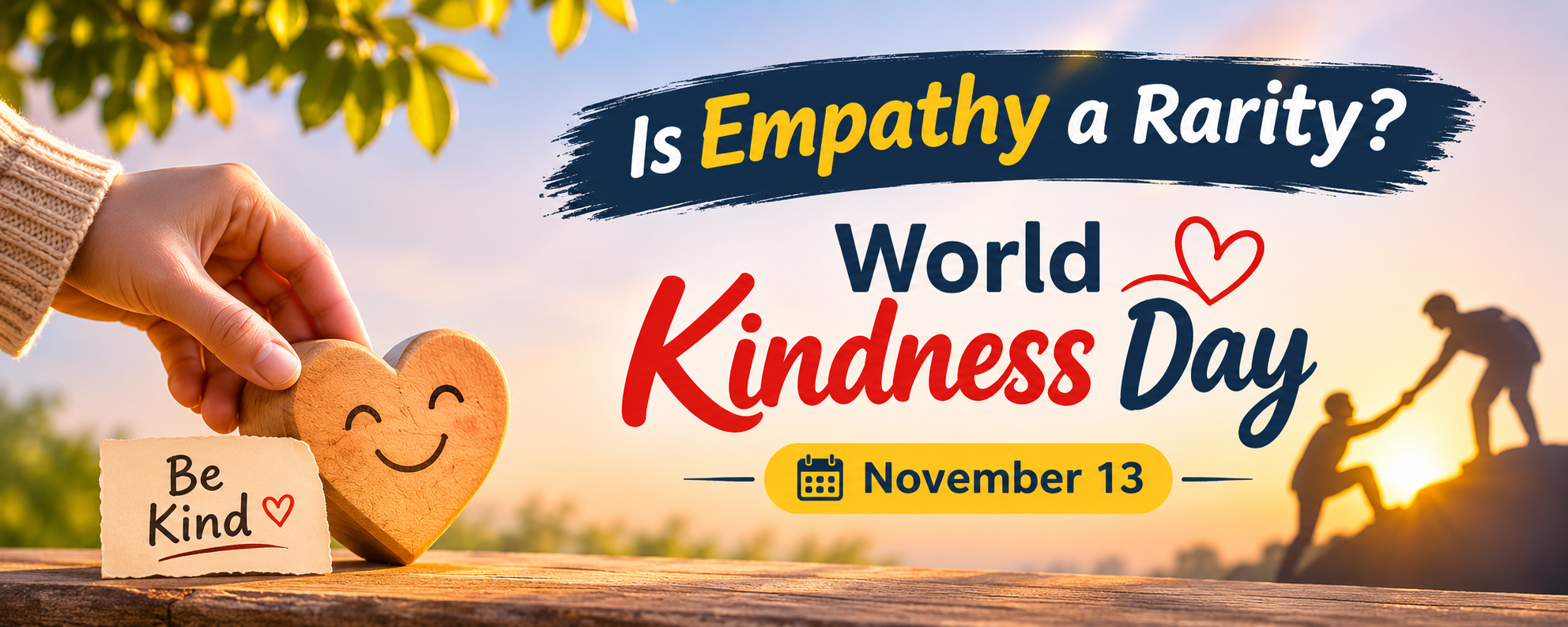
Is Empathy a Rarity?
World Kindness Day, celebrated globally on November 13, is a reminder of something the world can never have enough of: kindness.
The day highlights the positive power of empathy, compassion and love, and encourages us to look beyond our differences. A small act of kindness can bridge divides across race, religion, politics, gender and geography.
But in a world that moves faster every day, an uncomfortable question arises:
Is kindness becoming a rarity?
The Story Behind World Kindness Day
The roots of World Kindness Day can be traced back to 1997, when the Small Kindness Movement hosted a conference in Tokyo, Japan. Humanitarian organisations from different countries came together to discuss the need for a global alliance dedicated to promoting kindness.
That meeting led to the formation of the World Kindness Movement (WKM), a coalition of non-governmental organisations.
On November 13, 1998, the first World Kindness Day was launched.
What began with participation in countries such as Japan and Singapore has since grown into a global observance, with countries including India, Australia, Canada, the United Kingdom and the United States recognising the day.
The message is simple:
Kindness has no borders.
Kindness isn’t merely a pleasant social gesture. It can have a meaningful impact on our emotional and physical well-being.
Acts of kindness and positive social connection are associated with the release of chemicals such as oxytocin and serotonin, which can support emotional well-being, reduce stress and contribute to a sense of connection.
At a social level, empathy helps build something equally important: trust.
In a world struggling with loneliness, inequality, polarisation and online hostility, the ability to understand another person’s feelings—even when we don’t agree with their opinions—can help strengthen communities.
So, Is Empathy Really Becoming Rare?
In a fast-paced world dominated by screens, quick judgments and competing pressures, genuine empathy can certainly feel rare.
But psychologists and sociologists suggest that empathy isn’t necessarily disappearing. Our environment may simply be making it harder to practice.
We are busy. We are distracted. We are thinking about our deadlines, our finances, our families and our own problems.
Stress, financial pressures, professional competition and personal responsibilities can make us focus almost entirely on our own immediate needs.
When we are struggling to keep up, someone else’s struggle can become difficult to see.
Sometimes, we aren’t deliberately being insensitive.
We are simply running on autopilot.
The good news is that empathy can be strengthened.
Like a muscle, it grows with use.
Practice Small Acts of Kindness
Let’s start by being kind with our own family
A cheerful face and a genuine compliment is a great start.
Help an elderly neighbour with groceries.
Buy a cup of coffee for someone.
Leave an encouraging note.
Check in on someone who has been unusually quiet.
Share something positive instead of adding to the negativity online.
And sometimes, simply being there is enough.
Don’t Forget Yourself
Empathy also includes self-kindness.
Rest when you need to.
Forgive yourself for mistakes.
One person listening can change the course of a conversation.
One kind word can change someone’s day.
One compassionate response can prevent an argument.
One small act can inspire another.
And that is how kindness travels—from one person to another, creating a ripple far beyond the original gesture.
So, this World Kindness Day perhaps we should ask:
“Where can I bring a little more kindness?”
And there is no better place to begin than with the person standing right in front of us.
As the Dalai Lama reminds us:
“Be kind whenever possible. It is always possible.”