


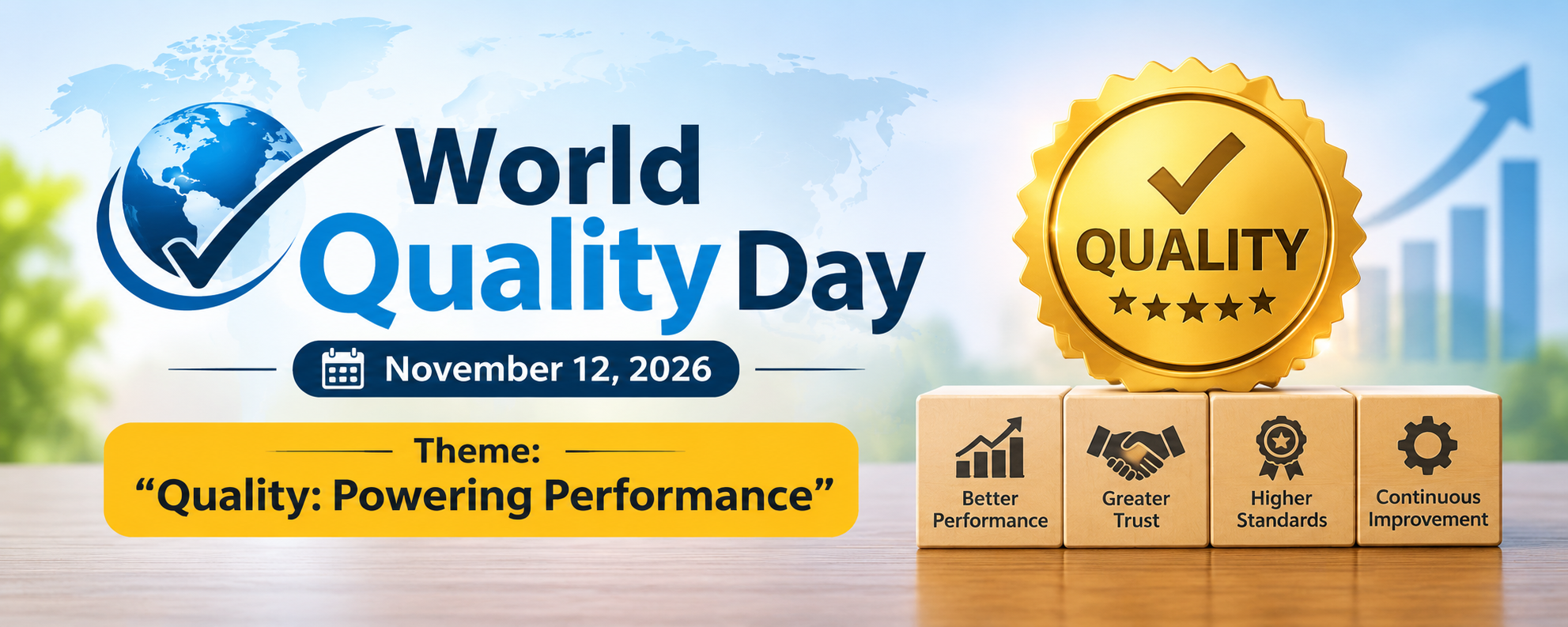
World Quality Day 2026 falls on November 12, with this year’s theme
“Quality: Powering Performance”
The theme captures an important truth about quality: quality is not simply about checking whether something has been done correctly. It is about creating the conditions for people, processes and organisations to perform better.
World Quality Day is observed globally to raise awareness about the vital role of quality in organisational growth, customer satisfaction, operational excellence and economic prosperity.
Because quality is not the responsibility of one department.
Quality is everyone’s responsibility.
Why Does World Quality Day Matter?
Quality touches almost everything an organisation does—from the products it makes and the services it delivers to the processes that support them.
Quality Drives Performance
High standards in products, services and processes can improve efficiency, reduce errors and help organisations perform consistently.
Quality encourages teams to look beyond simply meeting requirements and ask a more important question:
Can we do this better?
That mindset drives continuous improvement, innovation and better problem-solving.
Quality Protects Customers
Poor quality can result in defects, complaints, rework, repairs and recalls.
Good quality management, on the other hand, builds reliability and trust.
Ultimately, customers may forget an advertising campaign or a sales pitch.
They remember whether the product or service delivered on its promise.
Quality Protects Reputation
Reputation takes years to build and can be damaged by a single serious quality failure.
Consistent quality demonstrates that an organization respects its customers, its employees and the commitments it makes.
Quality Recognizes the People Behind Performance
Quality professionals, engineers, technicians, production teams, field staff and countless others work behind the scenes to ensure that products and services are safe, reliable and fit for purpose.
World Quality Day is also an opportunity to recognise their contribution.
Quality Has Four Dimensions
Quality can be viewed through four interconnected lenses:
1. Quality is Safety
First and foremost, quality is about safety.
A quality process protects the customer who uses the product and the employees and field teams who manufacture, install, operate or maintain it.
This gives quality an ethical dimension.
It is not merely about reducing failure rates or avoiding costs. It is about asking whether we are doing everything reasonably possible to protect people, communities and the environment.
A robust quality culture therefore begins with a simple principle:
Do it right because someone depends on it.
2. Quality Saves Costs
There is a misconception that quality is expensive.
In reality, poor quality is expensive.
Defects, warranty claims, transportation, repairs, replacements, rework and recalls can impose enormous financial costs on an organisation.
Investing in quality at the source can prevent these costs from occurring in the first place.
Quality therefore, can be one of the most effective forms of cost management.
3. Quality Creates Better Customer Experiences
Technology can be impressive. Products can be sophisticated. Services can be attractively packaged.
But if they fail to perform as promised, the customer experience suffers.
Quality therefore becomes a critical differentiator.
When customers know that a product or service will perform consistently, confidence grows.
And confidence builds loyalty.
Quality doesn’t simply satisfy customers. It gives them a reason to trust you again.
4. Quality Supports Sustainability
Quality and sustainability are closely connected.
Every defective product, unnecessary repair, repeat shipment, replacement or recall can consume additional materials, energy and resources.
Reducing waste through better processes therefore has an environmental as well as an economic benefit.
A strong quality culture can help organisations reduce rework, minimise waste and use resources more efficiently.
Better quality can mean less waste—and a smaller environmental footprint.
The Future of Quality
The future of quality will increasingly be shaped by data, analytics and digital technologies.
Feedback analytics can help organisations identify patterns, detect gaps and recognise deviations in processes much earlier.
Instead of waiting for a problem to become a failure, organisations can increasingly identify warning signals at the point where they occur and take preventive action.
This represents a fundamental shift:
From detecting problems to predicting and preventing them.
Artificial intelligence, automation, real-time monitoring and data analytics will make this possible at an increasingly sophisticated level. But technology alone cannot deliver quality.
The Human Element Still Matters
As digital tools become more powerful, there is a risk of assuming that technology can replace human judgement.
It cannot.
Quality depends on people who understand processes, recognise risks, question anomalies and take responsibility for outcomes.
The future will therefore not be about choosing between digital intelligence and human intelligence.
It will be about making the two work together.
People need to be trained, empowered and equipped to use digital tools with the same discipline and rigour that quality processes demand.
Because behind every system, every algorithm and every quality metric, there is a human decision.
The theme “Quality: Powering Performance” reminds us that quality is not an additional layer added to performance.
Quality is what makes sustained performance possible.
When quality improves, safety improves.
When quality improves, costs come down.
When quality improves, customer trust grows.
When quality improves, sustainability becomes stronger.
And when all of these come together, performance follows.
This World Quality Day, let’s not just measure quality.
Let’s make quality the force that powers better performance—every day. Let’s make Quality our Culture.