


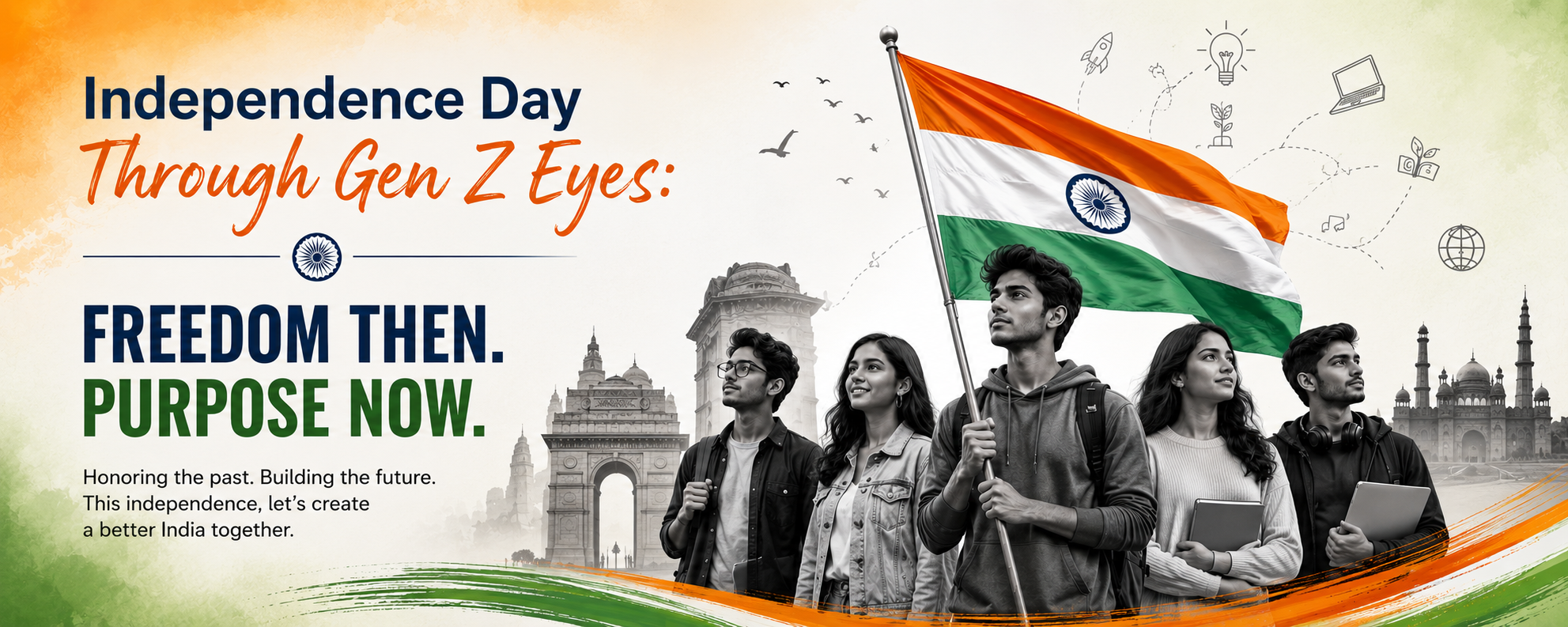
Independence Day Through Gen Z Eyes: Freedom Then. Purpose Now.
Every 15th August, the Indian tricolour rises across the nation, reminding us of the sacrifices that secured our freedom. But as India celebrates its 80th Independence Day, a new question deserves attention: What does freedom mean to Generation Z?
Born in a free and fast developing India, Gen Z has no living memory of colonial rule. Their understanding of the freedom movement comes through books, films, podcasts, documentaries, and digital media. Yet this doesn’t make them less patriotic—it simply means they express patriotism differently.
For earlier generations, including those born after Independence , the freedom struggle was closely tied to memories of sacrifice, Partition, and nation-building . India was still a young country struggling to make a mark and emerge as a flourishing nation. For today’s youth, New India and the new world demand a different focus , supported by speed , technology , innovation, entrepreneurship, sustainability, diversity, and social impact. They are less likely to ask, “How was freedom won?” and more likely to ask, “How can I use my freedom to build a better India?”
Freedom Has a New Meaning
The freedom won in 1947 gave India political independence. For Gen Z, freedom also means having the opportunity to shape their own future.
Today, freedom is about:
Choosing one’s career and aspirations.
Expressing ideas openly.
Equal opportunities regardless of gender or background.
Access to education and technology.
Mental well-being and individuality.
Creating innovative solutions.
Building a greener, more sustainable future.
Their aspirations are personal, but they ultimately contribute to national progress.
History Inspires When It’s Human
Young Indians are not disconnected from the freedom movement—they simply engage with it differently.
Rather than memorizing dates, they connect with stories of young revolutionaries, women leaders, tribal heroes, and ordinary citizens who displayed extraordinary courage. Learning that Bhagat Singh was only 23 when he was executed instantly makes history feel relevant to today’s students and young professionals.
Storytelling, films, immersive experiences, podcasts, and digital content have the power to make history meaningful for a new generation.
In the digital age, patriotism extends beyond flag-hoisting ceremonies and commemorative speeches.
Today’s youth express their love for India by:
Supporting Indian innovation and start-ups.
Promoting local artisans and indigenous products.
Championing sustainability.
Volunteering for social causes.
Preserving India’s cultural heritage.
Celebrating achievements in science, sports, and the arts.
Independence is not only a celebration of the past—it is a commitment to the future.
The freedom earned by earlier generations bring new responsibilities: strengthening democracy, protecting the environment, embracing diversity, driving innovation, and contributing to India’s global leadership.
Freedom is no longer just a political achievement. It is a shared responsibility.
The challenge for educators, institutions, governments, and brands is not to make history louder—but more relevant.
Replace statistics with stories. Replace lectures with conversations. Use immersive experiences, digital storytelling, and authentic narratives that connect the courage of yesterday with the aspirations of today. Focus more on the young freedom fighters who sacrificed their lives to make it more relatable.
When history becomes personal, Independence Day becomes more than a national celebration—it becomes a reminder that every generation has a role in shaping India’s future.
Independence is not the end of a journey—it is the beginning of every generation’s responsibility to build a stronger, more inclusive, and more prosperous India.