

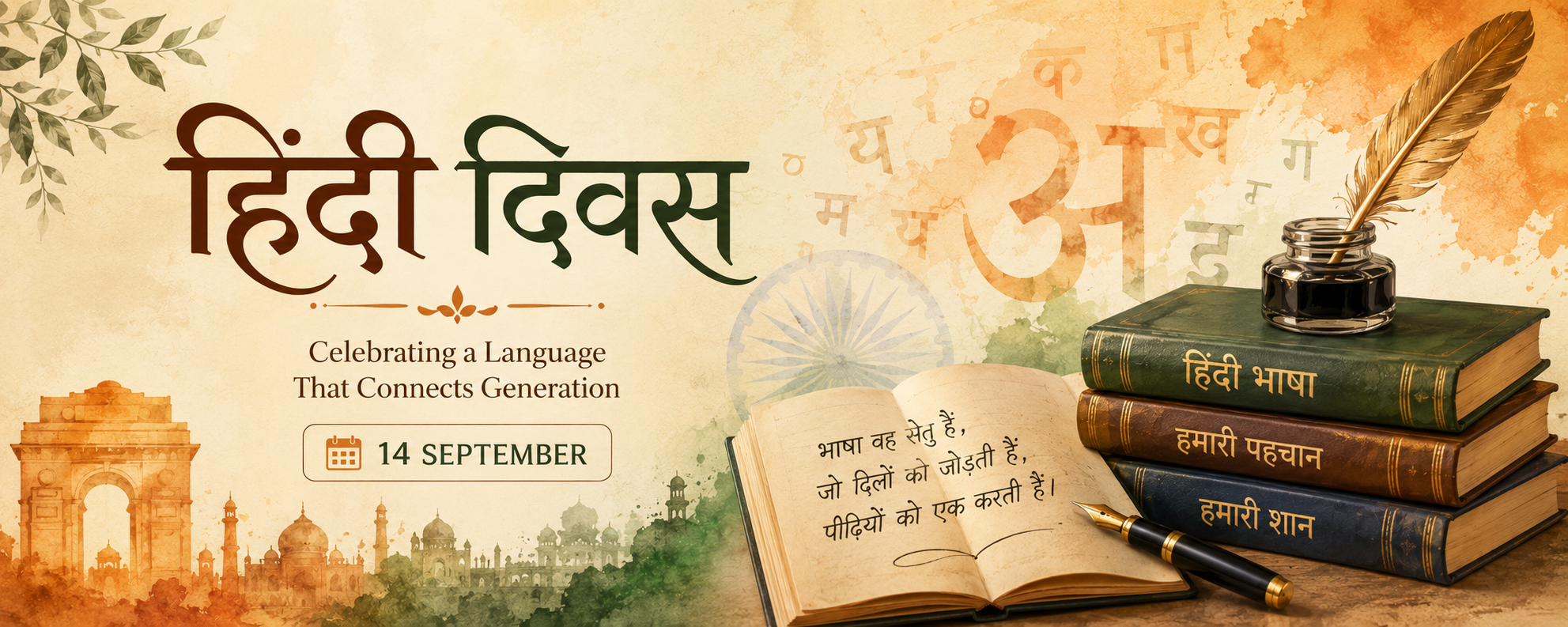
Hindi Diwas: Celebrating a Language That Connects Generations
क्या आप यह वाक्य पढ़ सकते हैं?
For millions of people, Hindi is a familiar and expressive language. It is heard at home, in classrooms, in films, in literature and in everyday conversations.
Bollywood has been the single most powerful driver for the global and national spread of Hindi. While formal Hindi is taught in schools, Bollywood created a conversational, accessible version that broke regional and cultural barriers.
Movies bypassed literacy barriers. Non-Hindi speakers learn by listening.
Cinema took Hindi worldwide. It gained massive fan bases in Russia, Germany, and Peru. Bollywood songs are played globally. Dance and lyrics hook foreign audiences.
Films bridged political language divides. Youth learned Hindi through songs.
NRIs use cinema to teach children Hindi. It maintains their cultural roots.
Yet, for many others, the ability to read and understand a language remains a privilege because they have not had access to education.
This Hindi Diwas, therefore, let us celebrate not just a language, but also the power of literacy and education to make that language accessible to everyone.
Why Do We Celebrate Hindi Diwas?
Hindi Diwas is observed every year on 14 September to commemorate the adoption of Hindi in the Devanagari script as one of the official languages of the Union of India on 14 September 1949.
The day is an opportunity to recognise the contribution of Hindi to India’s cultural and literary heritage and to encourage its wider use.
India is a country of extraordinary linguistic diversity. Hundreds of languages and dialects are spoken across the country, each carrying its own history, traditions and identity. In this diverse linguistic landscape, Hindi has emerged as an important language of communication, connecting millions of Indians.
A Language that has evolved
Hindi has never been a static language. It has continually adapted to changing times, embracing new words, expressions and ideas. Today, words from English and other Indian languages naturally find their way into everyday Hindi.
The Hindi of today is not necessarily the Hindi of yesterday—and that is a sign of its vitality. Modern Hindi comfortably lives alongside technology, social media, science, business and popular culture. New expressions emerge every day. Young people experiment with language, combining Hindi with English and other languages to create new forms of communication.Rather than weakening the language, this adaptability demonstrates its resilience.
From business and technology to entertainment and social media, Hindi continues to evolve with the world around it.
The use of Hinglish (blending English and Hindi) is growing more popular in India’s urban cities. From the popular ad slogans…”Yeh Dil Mange More” and “Hungry Kya” to Bollywood Film titles “Jab we met “. While popular Indian authors like Shobha De encourage the use of Hinglish, puritans of both English and Hindi strongly object. Language is for communication and if Hinglish connects then lets give it a place in our communication.
A living language changes with its people.
But millions of children and adults still lack adequate access to education and literacy. For them, the written word can remain a closed door—whether it is Hindi, English or any other language.
Celebrating a language should therefore go hand in hand with promoting literacy and education.
This Hindi Diwas, Let’s Open More Doors
And above all, let us help make the power of reading and education accessible to every child.