


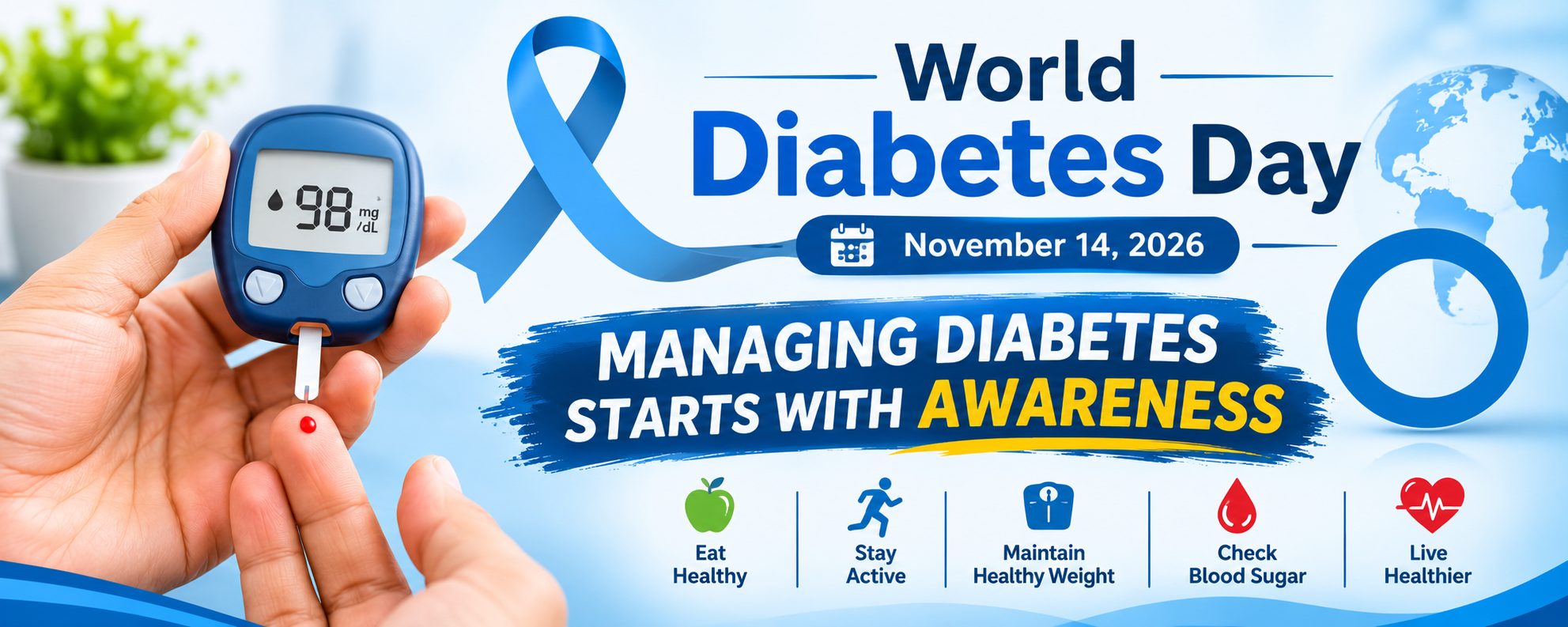
Managing Diabetes Starts With Awareness
November is Diabetes Awareness Month.
What if knowing your risk today could change your health tomorrow?
November is a time to talk about diabetes—not simply as a disease, but as a condition that can often be detected early, managed effectively and, in the case of type 2 diabetes, sometimes prevented or delayed. Because the first step is not always a prescription. Sometimes, it is awareness.
November 14 | World Diabetes Day
Every year, November 14 marks World Diabetes Day, commemorating the birthday of Sir Frederick Banting, one of the scientists associated with the discovery of insulin.
The internationally recognised symbol of diabetes awareness is the blue circle.
For 2026–27, the global campaign carries a particularly important message:
EARLY ACTION ON DIABETES
The focus is on early diagnosis and risk reduction—because type 2 diabetes can develop gradually and may cause few or no obvious symptoms in its early stages.
So perhaps the question this November should not simply be:
“Do I have diabetes?”
but also:
“Do I know my risk?”
DIABETES IS NOT JUST ABOUT SUGAR
Diabetes occurs when the body cannot regulate blood glucose effectively—because it does not produce enough insulin, cannot use insulin effectively, or both.
There are different types, and understanding the difference matters.
Type 1 diabetes
An autoimmune condition in which the immune system attacks the insulin-producing cells of the pancreas. It is not caused by lifestyle choices.
Type 2 diabetes
The most common form of diabetes. The body becomes less responsive to insulin and, over time, may not produce enough insulin to maintain healthy blood glucose levels. Genetics, ageing and lifestyle factors can all play a role.
Gestational diabetes
Diabetes that develops during pregnancy. It can increase the mother’s future risk of developing type 2 diabetes.
Different causes require different approaches.
That is why awareness should replace assumptions—and blame.
SO, WHAT INCREASES THE RISK OF TYPE 2 DIABETES?
There isn’t one single answer.Several factors can interact.
1. Weight and body composition
Excess body weight, particularly abdominal fat, can increase insulin resistance.
But weight is only one part of the picture. Diabetes can occur at different body weights, particularly when other risk factors are present.
2. Physical inactivity
Our muscles use glucose for energy. Regular physical activity helps the body use insulin more effectively.
A consistently inactive lifestyle can increase the risk of type 2 diabetes.
3. Family history
If a parent, brother or sister has type 2 diabetes, your risk may be higher.Genes matter.
4. Age and genetic background
The risk of type 2 diabetes generally increases with age.
Certain populations, including South Asian, East Asian, Black African and Hispanic/Latino populations, can have increased risk and may develop metabolic problems at younger ages or at lower body weights.
5. Other health conditions
High blood pressure, abnormal cholesterol or triglyceride levels, PCOS and a previous history of gestational diabetes can all be associated with increased risk.
6. Certain medications
Some medicines, including long-term corticosteroid treatment, can affect blood glucose or increase diabetes risk.
That does not mean stopping medication. Any concerns about medication and blood glucose should be discussed with a healthcare professional.
IS DIABETES REALLY A “LIFESTYLE DISEASE”?
It is a phrase we hear often.But it doesn’t tell the whole story.
Yes, physical activity, diet, sleep and weight can influence the risk of type 2 diabetes.
But so can genetics, age, family history, hormones, other health conditions and the environment in which we live.
Two people can have similar lifestyles and still have very different levels of risk.
So let’s change the conversation.
Diabetes awareness is not about blame.It is about understanding risk and taking action.
WHERE BIOLOGY MEETS LIFESTYLE
Our bodies are constantly working to keep blood glucose within a healthy range.
When insulin resistance develops, the pancreas may initially compensate by producing more insulin.
Over time, however, the body’s ability to maintain normal blood glucose can become impaired.
This is where healthy habits can make a difference.
Move more.
Eat thoughtfully.
Sleep adequately.
Maintain a healthy weight where appropriate.
Don’t smoke.
Take prescribed medication as advised.
For people living with type 2 diabetes, lifestyle changes combined with appropriate medical treatment can improve blood glucose control. Some people may achieve remission, but diabetes management remains individual and should be guided by a healthcare professional.
There is no universal “diabetes diet”.
There is no one exercise programme that suits everyone.
And there is no substitute for personalised medical advice.
EARLY ACTION STARTS WITH KNOWING YOUR NUMBERS
One of the most powerful messages of Diabetes Awareness Month is simple:
DON’T WAIT FOR SYMPTOMS.
Type 2 diabetes can remain unnoticed for years. Early detection gives people an opportunity to act before complications develop.
Depending on your individual risk, a healthcare professional may recommend checking:
Blood glucose / HbA1c
To assess blood glucose levels and longer-term glucose control.
Blood pressure
Because high blood pressure commonly accompanies diabetes and can add to cardiovascular risk.
Cholesterol and triglycerides
Because abnormal blood lipids, together with diabetes, can increase the risk of cardiovascular disease.
Regular screening can be particularly important if you have a family history of diabetes, excess weight, high blood pressure, previous gestational diabetes or other recognised risk factors.
AWARENESS SHOULD NOT CREATE FEAR
A diabetes diagnosis can be overwhelming.
Suddenly, ordinary questions can feel enormous:
What can I eat?
Will I need medication?
Can I still exercise?
Do I have to give up everything I enjoy?
Will my life change completely?
These concerns are real.
But a diagnosis does not have to become a sentence of limitation.
Diabetes can be managed.
Its complications can often be prevented or delayed with appropriate treatment, monitoring and healthy habits.
And the earlier we know, the earlier we can act.
SO, WHERE DOES THE WAY FORWARD BEGIN?
Perhaps it begins before the medicine.
Before the treatment plan.
Before the diagnosis becomes a complication.
It begins with awareness.
Knowing your family history.
Understanding your risk.
Getting tested when appropriate.
Knowing your numbers.
Moving a little more.
Eating a little better.
Taking prescribed treatment seriously.
And asking questions instead of ignoring warning signs.
Because having diabetes does not mean giving up on a healthy, active and fulfilling life.
THIS NOVEMBER, LET THE BLUE CIRCLE MEAN MORE.
Let it stand for:
EARLY DETECTION. INFORMED CHOICES. TIMELY ACTION. BETTER CARE. HOPE OF REVERSAL