


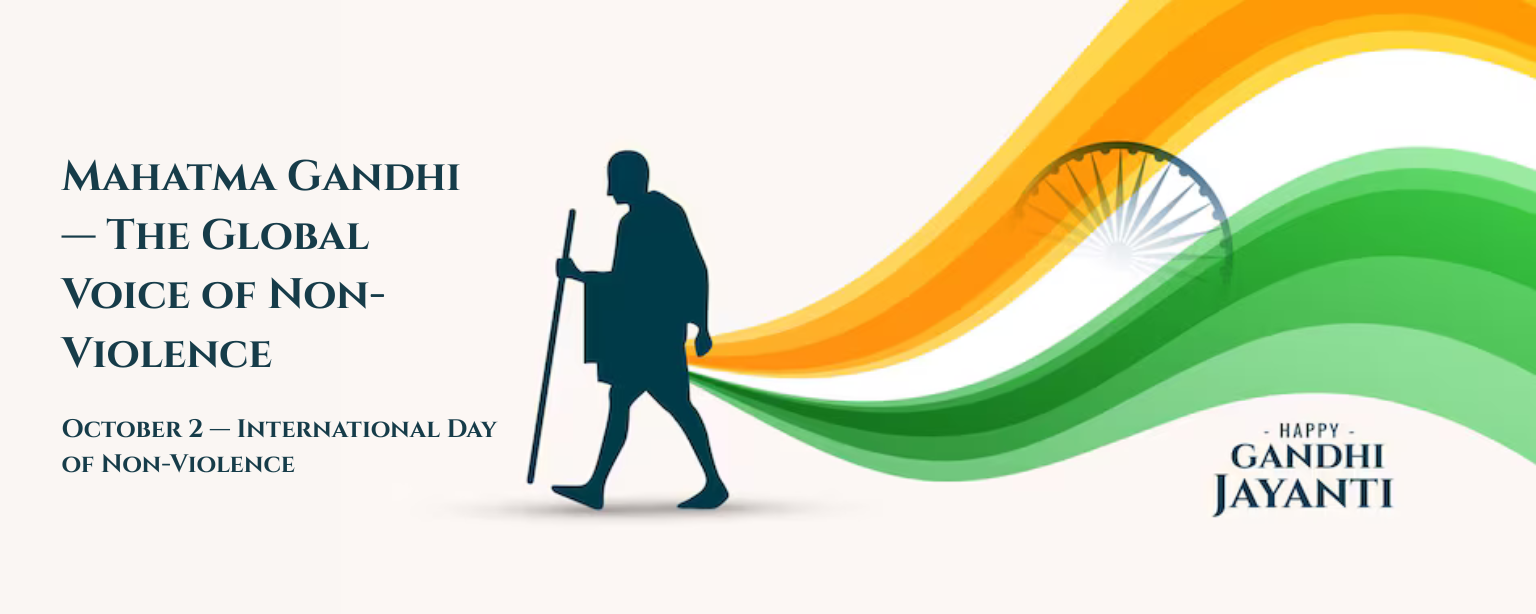
Mahatma Gandhi — The Global Voice of Non-Violence
October 2 is observed as the International Day of Non-Violence, coinciding with the birth anniversary of Mahatma Gandhi, who led India’s independence movement and pioneered the practice of non-violent resistance.
The idea of an International Day of Non-Violence was proposed at the World Social Forum in Mumbai in 2004 by Iranian Nobel Peace Prize laureate Shirin Ebadi. On June 15, 2007, the United Nations General Assembly adopted a resolution establishing October 2 as the International Day of Non-Violence. Introduced by India and supported by more than 140 nations, the resolution reflected the worldwide recognition of Gandhi’s philosophy.
The objective is to spread the message of non-violence through education and public awareness and to promote a culture of peace, tolerance and understanding.
Non-violence, however, is not passivity. Gandhi demonstrated that injustice could be challenged through strikes, boycotts, civil disobedience and non-cooperation. The Salt March of 1930 remains one of the most powerful examples of this approach.
From India to the World
Gandhi’s philosophy of Ahimsa continued to influence movements long after India’s independence. Martin Luther King Jr. drew upon Gandhian principles during the American civil rights movement, while Nelson Mandela also acknowledged Gandhi’s influence, even though his own political journey unfolded in very different circumstances.
At the heart of Gandhi’s philosophy were three interconnected ideas:
Satyagraha — Truth-Force: The active pursuit of truth and justice without hatred towards one’s opponent.
Ahimsa — Non-Violence: Not merely the absence of physical violence, but an effort to reject hatred, cruelty and ill-will.
Sarvodaya — Welfare of All: The belief that true progress must include the poorest and most vulnerable.
Gandhi on Peace and Sustainability
Gandhi left behind many enduring reflections on peace and human conduct:
“An eye for an eye only ends up making the whole world blind.”
“The weak can never forgive. Forgiveness is the attribute of the strong.”
His thinking also anticipated questions that are central to today’s sustainability debate.
His famous words—
“Earth provides enough to satisfy every man’s needs, but not every man’s greed.”
—continue to resonate in an age of overconsumption and growing environmental concerns.
His emphasis on responsible consumption and stewardship of natural resources also echoes today’s principle of intergenerational responsibility—the idea that we have obligations towards those who will inherit the world from us.
The Man of Contradictions
Gandhi was far from an uncomplicated historical figure. He is often described as a “man of contradictions”, and his life continues to be examined and debated.
His advocacy of non-violence sits alongside his support for Indian recruitment to the British military during the First World War. His early views on race when in South Africa, his personal orthodoxies and several of his political positions have also attracted criticism and scholarly scrutiny.
Acknowledging these contradictions does not diminish the importance of studying Gandhi. Rather, it allows us to see him as a complex historical figure whose ideas, actions and limitations all form part of his legacy.
Why Gandhi Still Matters
Gandhi demonstrated that moral courage, collective action and non-violent resistance could become powerful forces for political and social change.
The title “Mahatma”, meaning “Great Soul” in Sanskrit, came to be associated with him because of his moral and spiritual influence and his lifelong emphasis on truth, non-violence and service.
This October 2, we can remember Gandhi not as a flawless icon, but as a remarkable and complex human being whose ideas continue to challenge us.
A man can be questioned.
A philosophy can be debated.
But an idea that inspires generations deserves to be understood.